

Systematic loss
Not "down on the year" — loss that is too consistent, across regimes, to read as variance.
AlphaBetaCigma
A forensic investigation into whether some Polymarket wallets lose on purpose — sacrificing their own money to move markets for a hidden winner cluster — and whether countertrading them pays.
We investigate. We do not trade on this and do not recommend anyone else does.


01 · The Idea
The obvious read on a wallet with a terrible record: bad judgment, bad luck, tilt, emotional bias. For most accounts that is almost certainly true. This site is about the other category.
Prediction markets are unusually exposed: wallet activity is public, copytrading exists, liquidity can be thin, and visible trades change how everyone else reads a market. In that environment a wallet could lose intentionally because the loss creates value elsewhere — feeding exit liquidity to a confederate, manufacturing volume, or shaping sentiment so a coordinated winner cluster profits.
The asymmetry is the whole point. Winner wallets are deliberately obscured — edge hidden behind mixed-in losses and split clusters. The sacrificial losers are sloppier and followable, because nobody expects them to be valuable. So the sharper question is: would countertrading the right loser beat copytrading any visible winner?

02 · Why we think this might be happening
This is a hypothesis, not an accusation. But sacrificial flow is a known pattern elsewhere, and independent research already finds coordinated, self-dealing wallet structure on Polymarket itself.
Pump-and-dump
Visible coordinated flow manufactured to move a price for someone else’s exit.
Crypto wash trading
Self-dealing volume that fakes liquidity and interest — already measured here.
Sports-betting steam
Sacrificial early bets that move a line so confederates get a better number.
Dark-pool / spoofing
Orders placed to be seen, not filled — signal as a weapon.
Sirolly, Ma, Kanoria & Sethi — Columbia / Barnard (SSRN) · 2025-11-06
Flags ~14% of Polymarket’s 1.26M wallets with wash-trading-consistent activity; one cluster of 43k+ wallets transacting mostly with each other.
arXiv preprint 2603.03136 · 2026
Wallet-level structure of a flagship Polymarket event — useful baseline for what "normal" concentration looks like.

Fortune · 2025-11-07
Artificial trading averaged ~25% of volume over three years; 45% of sports-market activity.
CoinDesk · 2026-04-29
The asymmetry our thesis rests on: a small, well-hidden winner cluster on one side.
CoinDesk · 2025-11-07
Wallets that trade almost exclusively with one another — the signature of coordination.
CoinDesk · 2026-02-27
Evidence that informed, coordinated actors operate on-platform — not just retail noise.

CNN Politics · 2026-03-30
The integrity question is now a law-enforcement question.
The Block · 2026
Platforms now explicitly police spoofing, wash trading and front-running — i.e. they concede it happens.
Full research dossier Origin: a hypothesis posed in r/algotrading — countertrade the consistent losers, don\'t chase the winners.

03 · How we investigate
Raw win rate proves nothing. The hard part is discrimination: a real bad trader still loses in a recognizably human way. We score timing, price entry, size, counterparty relationships, correlated wallet behaviour and post-entry market movement — then explicitly try to explain each loser as a mere bad trader, hedger, or unlucky low-sample account before flagging anything.
Pipeline: manual collectors → Parquet → DuckDB → feature extraction (timing, price, size, counterparty) → countertrade simulator (delay + slippage) → engineered-loser ranking, with explicit discriminators for ordinary bad traders, hedgers and unlucky wallets.
Not "down on the year" — loss that is too consistent, across regimes, to read as variance.

Entries clustered at precise, algorithmic moments rather than human, narrative-driven ones.
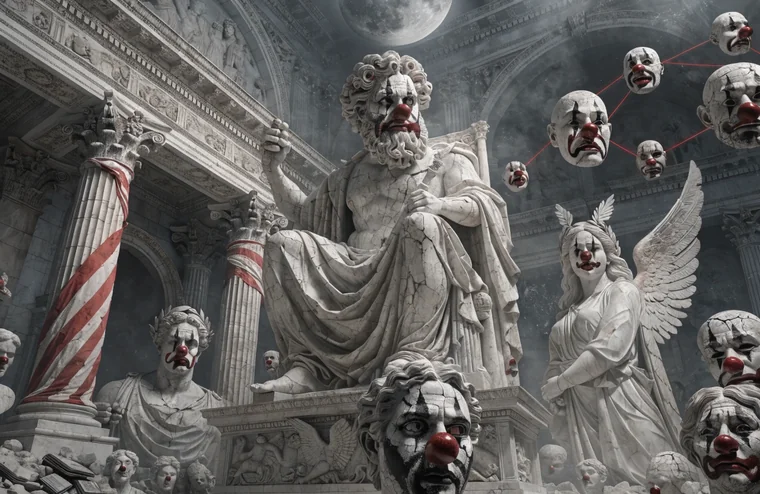
Losers that trade mostly with the same small set of counterparties, again and again.
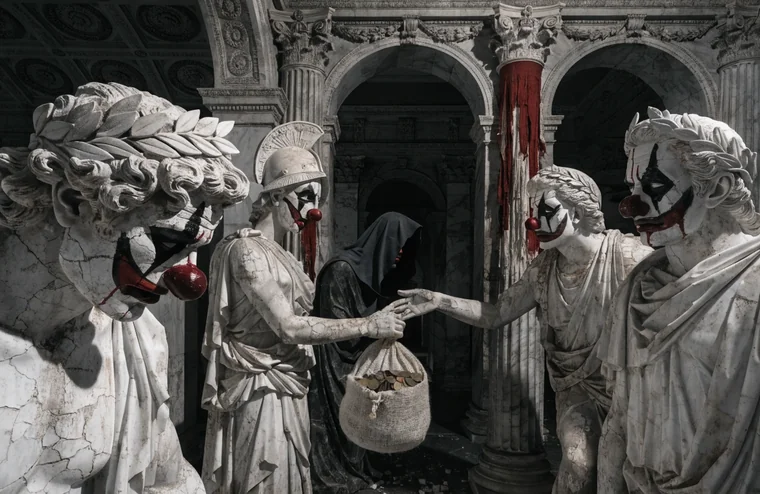
Losses that reliably land exactly where another wallet needs someone to take the other side.

Visible bad bets that exist to shape how everyone else reads a thin market.

If the loss is engineered, countertrading it — net of delay and slippage — should pay.

04 · Tech stack
SvelteKit. Compiles away the framework: a fast, mostly-static site that still does rich interaction where it earns it.
DuckDB. A columnar analytical engine in a single file — perfect for slicing a couple of GB of trades on one box.
Parquet. Compressed columnar raw storage DuckDB reads directly. Cheap to keep, cheap to re-scan.
Apache ECharts. A deep chart vocabulary for scatter, heatmap and histogram views of wallet behaviour.
D3 + Mermaid. Mermaid documents the pipeline; D3 draws the wallet-relationship graphs where the thesis lives.
FastAPI. A thin, typed read-only layer that only ever runs pre-registered SQL — never client input.
ABC is an independent research investigation. Nothing here is financial, investment or trading advice. We do not trade on this data and we do not recommend anyone else does. Findings are exploratory: worst case it is a dead end; best case there is a class of profitable losers hiding in plain sight. The marble-clown identity is satire, not a claim about any named person or wallet.
Questions, corrections, data leads: abc@gamingworld.uk